
Forty-Two Game Changers Shaping the Cyber Security Space in the Coming Decade
- Hillel Kobrovski

- 21 בפבר׳
- זמן קריאה 6 דקות
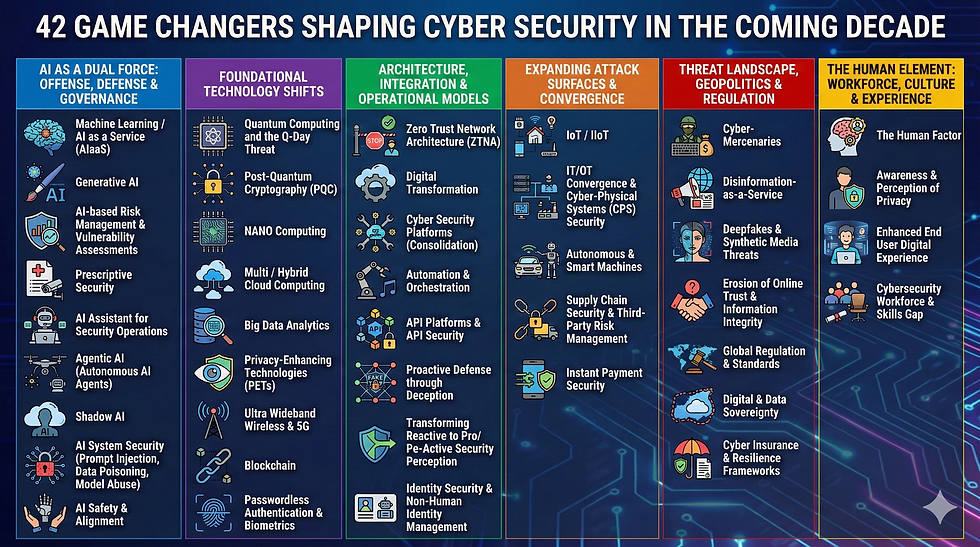
42 Game Changers Shaping Cyber Security in the Coming Decade
A predictive view of the technologies, architectures, threats, regulations, and human factors that will redefine cybersecurity over the next ten years, with AI as the primary disruptive force shaping both attack and defense.
1. AI as a Dual Force: Offense, Defense & Governance
AI will be the single biggest driver of change in cybersecurity, simultaneously empowering defenders and supercharging attackers. Organizations will need to secure AI systems themselves, govern autonomous AI agents, and manage the risks of shadow AI and data leakage, while using AI to transform SOC operations and move from reactive to proactive defense.
Machine Learning / AI as a Service (AIaaS) – Cloud-delivered AI models that automate detection, hunting, and response, while also giving attackers easy access to powerful offensive capabilities.
Generative AI – Models that can create phishing content, malware code, and deepfakes at scale, but also automate playbook generation, report writing, and enrichment in the SOC.
AI-based Risk Management & Vulnerability Assessments – AI engines that continuously prioritize vulnerabilities, misconfigurations, and business risks based on real exploitability and impact rather than static CVSS.
Prescriptive Security – Systems that not only predict threats but recommend or automatically execute specific remediation actions, shrinking mean time to respond.
AI Assistant for Security Operations – Conversational copilots that replace traditional GUIs for analysts, enabling natural-language investigation, hunting, tuning, and configuration changes across the security stack.
Agentic AI (Autonomous AI Agents) – Task-driven AI agents that can operate semi‑autonomously across networks and systems, becoming both a powerful defense tool and a new high-impact attack vector when compromised.
Shadow AI – Unapproved use of public or consumer-grade AI tools by employees, causing uncontrolled data leakage, lack of logging, and blind spots for security teams.
AI System Security (Prompt Injection, Data Poisoning, Model Abuse) – Attacks that target the AI itself, manipulating prompts, training data, or model behavior to bypass controls or exfiltrate sensitive information.
AI Safety & Alignment – Ensuring AI systems reliably follow intended goals and safety constraints, stay under meaningful human oversight, and avoid unintended harm even when no attacker is present. This includes limiting the harms of hallucinations, reducing bias in security decisions, and enforcing guardrails and kill switches for autonomous and agentic AI in critical environments.
2. Foundational Technology Shifts
Foundational shifts in computing, connectivity, and cryptography will reshape the attack surface and force organizations to rethink core cybersecurity primitives concepts. Quantum, 5G, big data, and privacy‑enhancing technologies will simultaneously enable new capabilities and introduce new systemic risks.
Quantum Computing and the Q-Day Threat – Future large-scale quantum systems that can break today’s public-key cryptography, forcing a redesign of long-term confidentiality and key management strategies.
Post-Quantum Cryptography (PQC) – New cryptographic algorithms designed to withstand quantum attacks, requiring a multi‑year migration of protocols, hardware, and applications.
NANO Computing – Ultra-dense, low-power computing at the nanoscale that shrinks devices, embeds computing into everyday objects, and creates new micro‑surfaces for attack and tampering.
Multi / Hybrid Cloud Computing – Complex, distributed environments where workloads span multiple hyperscalers and on‑prem, increasing misconfigurations and identity sprawl if security is not unified.
Big Data Analytics – The ability to correlate massive volumes of telemetry, business data, and threat intelligence to detect subtle patterns and low-and-slow attacks that traditional SIEMs miss.
Privacy-Enhancing Technologies (PETs) – Techniques such as homomorphic encryption and secure multi-party computation that enable analytics over sensitive data while meeting strict privacy regulations.
Ultra Wideband Wireless & 5G – High‑bandwidth, low‑latency connectivity that connects billions of devices and edge nodes, widening the attack surface but enabling near real‑time security controls.
Blockchain – Distributed ledgers used for integrity, non‑repudiation, and provenance (e.g., supply chain tracking, software bill of materials), but also targeted for key theft and smart contract exploits.
Passwordless Authentication & Biometrics – Passkeys, device‑bound credentials, and biometrics that gradually eliminate passwords, reducing phishing and credential stuffing while shifting risk to device and identity management.
3. Architecture, Integration & Operational Models
Security is shifting from siloed point products to integrated platforms and zero‑trust architectures. At the same time, identity (human and non‑human) becomes the new perimeter, and security operations move toward high levels of automation, orchestration, and deception‑driven proactive defense.
Zero Trust Network Architecture (ZTNA) – A “never trust, always verify” model where access decisions are continuous and identity-, device-, and context-aware, replacing perimeter-based controls.
Digital Transformation – Migration of core business processes to SaaS, cloud, and APIs, collapsing traditional perimeters and demanding cloud-native and identity-first security designs.
Cyber Security Platforms (Consolidation) – also known as the Gartner Cybersecurity Mesh Architecture (CSMA) concept. Integrated security ecosystems that replace fragmented point solutions with unified data, policy, and control planes across network, endpoint, cloud, and identity.
Automation & Orchestration – SOAR and workflow engines that automate repetitive tasks, triage, and containment actions, allowing small teams to handle large alert volumes.
API Platforms & API Security – Protection of the “connective tissue” of modern applications, focusing on authentication, abuse detection, input validation, and discovery of shadow and zombie APIs.
Proactive Defense through Deception – Use of honeypots, honeytokens, and decoy assets to detect attackers early, waste their time, and collect high‑fidelity signals inside the environment.
Transforming Reactive to Pro/Pre‑Active Security Perception – Organizational shift from waiting for alerts to continuous threat hunting, attack surface management, and intelligence‑driven prevention.
Identity Security & Non‑Human Identity Management – End‑to‑end control of human, service, machine, and AI identities, including least‑privilege entitlements in cloud (CIEM) and governance of API keys and tokens.
4. Expanding Attack Surfaces & Convergence
The attack surface is exploding as IT, OT, and IoT converge into cyber‑physical systems, and as payments, vehicles, and industrial environments go fully digital. Security must now cover everything from factory floors and smart cities to instant payments and autonomous machines.
IoT / IIoT – Massive fleets of often insecure or unpatchable devices in homes, hospitals, factories, and cities, providing attackers with entry points and lateral movement paths.
IT/OT Convergence & Cyber‑Physical Systems (CPS) Security – Integration of industrial control systems with IT networks, where cyber incidents can cause real‑world physical damage and safety risks.
Autonomous & Smart Machines – Self-driving vehicles, robots, and drones that rely on complex software stacks and connectivity, making safety, reliability, and integrity a core security concern.
Supply Chain Security & Third‑Party Risk Management – Attacks that compromise software suppliers, MSPs, and open‑source dependencies to reach many downstream victims in a single campaign.
Instant Payment Security – Real‑time payment rails and digital currencies that leave almost no time for fraud detection, driving a need for pre‑transaction risk scoring and strong identity assurance.
5. Threat Landscape, Geopolitics & Regulation
Cyber risk is now tightly coupled with geopolitics, regulation, and information integrity. Nation‑states, cyber‑mercenaries, and disinformation‑as‑a‑service will operate in an environment shaped by global standards, digital sovereignty demands, and fast‑evolving cyber‑insurance and resilience expectations.
Cyber‑Mercenaries – Commercial hacking groups selling advanced offensive capabilities, often blurring the line between criminals and state-sponsored actors.
Disinformation‑as‑a‑Service – Organized, paid campaigns that weaponize social platforms and generative AI to manipulate opinion, markets, and political stability.
Deepfakes & Synthetic Media Threats – AI‑generated text, visual image, audio, video, and live stream used for fraud, extortion, and social engineering, eroding trust in digital evidence and identities.
Erosion of Online Trust & Information Integrity – Growing difficulty in distinguishing authentic from manipulated content, pushing demand for content provenance, watermarking, and verification mechanisms.
Global Regulation & Standards – Expanding regimes such as NIS2, DORA, EU AI Act, and sectoral rules that drive minimum security baselines, reporting obligations, and board‑level accountability.
Digital & Data Sovereignty – National and regional requirements for data residency, cloud sovereignty, and control over critical digital infrastructure and technology stacks.
Cyber Insurance & Resilience Frameworks – Insurance markets that increasingly condition coverage on robust controls and resilience measures, shaping how organizations invest in security.
6. The Human Element: Workforce, Culture & Experience
Humans remain both the weakest link and the greatest asset in cybersecurity. The next decade will be shaped by how organizations close the skills gap, build a security‑aware culture, and deliver secure‑by‑design experiences that users actually accept and adopt.
The Human Factor – Human error, social engineering, and insider behavior remain the primary initial access vector despite technological advances.
Awareness & Perception of Privacy – Rising public and regulatory expectations around data protection, forcing organizations to be transparent and privacy‑by‑design in their security choices.
Enhanced End User Digital Experience – Secure‑by‑default and low‑friction experiences (e.g., passwordless, adaptive auth) that reduce workarounds and make the secure path the easiest path for users.
Cybersecurity Workforce & Skills Gap – A global shortage of millions of cyber professionals, driving investment in training, automation, and AI augmentation to close capability gaps.
Hillel Kobrovski , Last update: 21.02.2026



תגובות